Key Summary:
Online uniform suppliers cannot guarantee consistency because they lack control over production variables such as fabric batches, machine calibration, embroidery digitising, Pantone dye matching, sizing blocks, QC checkpoints, and post-production inspection. Uniform consistency is an engineered process involving stabilised materials, standardised measurement systems, calibrated embroidery machines, and controlled workflow environments — elements only professional manufacturers can provide.
When companies order uniforms online, from marketplace sellers or generic overseas suppliers, they often expect the same level of consistency they would get from a professional manufacturer. But the reality is different.
Uniform production is not simply “print, sew, ship.”
It is precision engineering.
Every colour, stitch, measurement and fabric behaviour must be controlled and repeatable across hundreds or thousands of pieces. When consistency is missing, your team ends up wearing garments that:
- fit differently
- feel different
- look different
- don’t match your branding
Online suppliers struggle to guarantee consistency because they lack control, standardisation, and engineering processes.
Here’s why.
1. Consistency Starts With Controlled Fabric Batches — Something Online Sellers Don’t Manage
Professional manufacturers use stabilised fabric sources with verified composition and dye accuracy.
Online suppliers often switch fabrics based on:
- what’s cheaper
- what’s left in the warehouse
- what the subcontractor has available
- what ships fastest
The fabric you saw in the photo may not be the material you receive.
How this affects consistency:
- Colour tones vary across batches
- Fabric weight and thickness change
- Shrinkage levels differ
- Breathability and comfort fluctuate
In uniform production, fabric stability is everything. Without it, consistency is impossible.
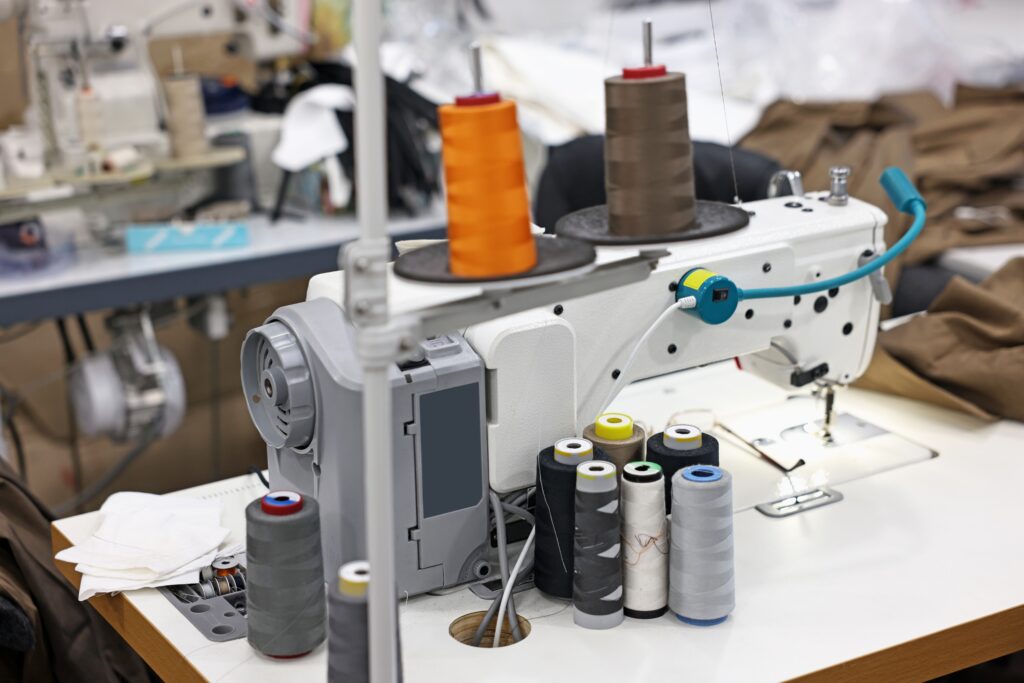
2. Machine Calibration Determines Stitch Quality and Online Sellers Don’t Calibrate
Embroidery machines are like industrial printers:
If not calibrated daily, results vary drastically.
Calibration controls:
- thread tension
- needle penetration
- stitch density
- line precision
- logo alignment
Marketplace sellers typically do not calibrate between orders because their priority is volume, not precision.
What happens when there’s no calibration:
- logo edges appear jagged
- thread gaps appear
- colours look uneven
- design shrinks or warps
- stitches loosen after washing
Professional uniform manufacturing requires technical maintenance, not guesswork.
3. Embroidery Digitising Is a Skill, Not a Software Button
Many online vendors rely on cheap auto-digitising software.
Professional embroidery requires a highly trained digitiser who understands:
- stitch direction
- density
- Layering
- pull compensation
- texture mapping
- fabric behaviour
Digitising determines whether an embroidered logo looks:
- premium
- flat
- messy
- distorted
- or completely unreadable
Online suppliers rarely invest in skilled digitisers, which is why logos almost never match the mockup.
4. Colour Consistency Requires Pantone-Controlled Dye Matching
Brands spend years refining their colour identity but online suppliers often use generic dye lots.
Without Pantone control:
- your company’s navy blue becomes midnight
- your red becomes neon
- your green becomes olive
Colour inconsistency is one of the most damaging uniform issues because it breaks your brand identity instantly.
Professional manufacturers:
- run lab dips
- match Pantone codes
- document dye formulas
- keep dye standards for future reorders
Online sellers cannot do this because they don’t control fabric dyeing at all.
5. Sizing Blocks Are Engineering Assets, Not “S, M, L” Labels
Accurate sizing is one of the most complex parts of uniform production.
Professional manufacturers use:
- industrial pattern blocks
- garment grading rules
- human fit models
- size calibration across fabrics
Online sellers simply offer generic sizes (S, M, L), often copied from unrelated garments.
This leads to:
- tight shoulders
- inconsistent sleeve lengths
- shirts that shrink by 1–2 sizes
- waistlines that vary by 3–5 cm
- completely different fits for the same size
Uniform sizing must be engineered, tested, and refined, not guessed.
6. QC Is a Multi-Stage System; Online Sellers Don’t Have One
Professional uniform manufacturers enforce multi-stage quality control:
- Pre-sewing inspection
- In-line QC
- Embroidery/printing inspection
- Final measurement checks
- Packaging checks
- Batch approval
Online vendors typically:
- check only one sample
- don’t inspect during production
- don’t measure each piece
- don’t reject defects
- pack whatever the factory sends
That’s why companies receive:
- crooked logos
- loose threads
- uneven stitching
- different shades in one order
- wrong sizes mixed together
Uniform consistency cannot exist without QC.
QC cannot exist without proper workflows.
Online sellers have neither.
7. Repeat Orders Cannot Be Replicated Without Production Records
Corporate uniforms need consistency not just today, but in:
- 6 months
- 1 year
- future hires
- new store openings
Professional manufacturers maintain:
- fabric batch records
- embroidery files
- thread colours
- machine settings
- pattern blocks
- fit notes
- QC reports
This ensures every future order matches the first order.
Online sellers?
They do not keep records or even use the same factory twice
8. Why Engineering-Based Production Matters for Branding
Uniforms are not disposable fashion. They represent:
- your brand identity
- your reputation
- your professionalism
- customer perception
- team morale
When consistency fails, it reflects directly on your business.
Professional uniform manufacturers protect that consistency with engineering-driven systems. Online suppliers simply cannot.
Conclusion: Consistency Is Not Cheap; It Is Designed
At Ark Industries, we use engineering-grade processes to deliver consistency across every batch:
- Pantone-controlled colour matching
- Calibrated embroidery machines
- Skilled digitising specialists
- Stabilised fabric sourcing
- Industrial sizing blocks
- Multi-stage QC and final inspection
- Full documentation for repeat orders
This is how we guarantee the same quality, every single time. Start your uniform project with Ark Industries today and speak to our uniform specialist to ensure brand consistency.