Key Summary:
Embroidered apparel can make an employee welcome kit more useful by giving new hires a practical item that connects them visibly to the organisation. Unlike event-specific merchandise, a well-made embroidered polo, jacket or cap can be worn during onboarding, company events, client-facing activities and team programmes. For Singapore employers, the strongest welcome-kit apparel combines a restrained embroidered logo with breathable fabric, inclusive sizing and a documented design specification that supports consistent future orders.
Employee welcome kits have become a familiar part of onboarding in Singapore. A new hire may receive stationery, a reusable bottle, an access-card holder and several branded items on their first day.
The intention is positive, but the real value of the kit depends on what remains useful after it has been opened.
A well-designed embroidered polo, jacket or cap can continue serving the employee throughout their time with the organisation. It may be worn during orientation, company events, training sessions, exhibitions, volunteering programmes or designated casual days.
This makes embroidered apparel more than another piece of corporate merchandise. When selected properly, it becomes part of a practical and repeatable onboarding system.
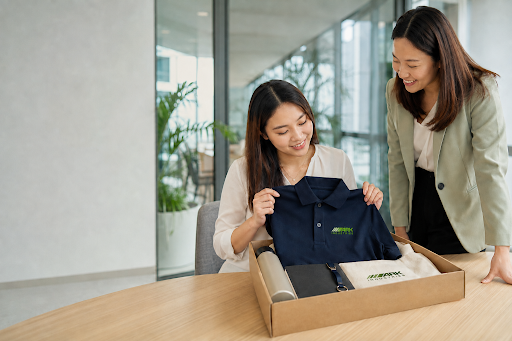
A Welcome Kit Should Be Useful Beyond the First Day
A welcome kit cannot replace clear responsibilities, proper introductions or access to the tools an employee needs. Apparel serves a different purpose: it gives the new hire a visible sign that they are now part of the organisation.
This can be particularly useful during the first few weeks, when employees may attend orientation sessions, town halls, team activities or company photographs. Providing an approved piece of corporate apparel removes uncertainty over what to wear and allows new employees to participate alongside established colleagues.
The garment should therefore be designed for continued use rather than the initial unboxing moment. If employees are unlikely to wear it again, it has not added much value to the onboarding experience.
Why Embroidery Works for Welcome-Kit Apparel
Printing and embroidery both have valid uses. Printing may be more suitable for large graphics, detailed artwork or lightweight event shirts. Embroidery is particularly effective when a company wants a compact, established-looking brand mark on a garment intended for repeated wear.
Because the design is stitched into the fabric, embroidery creates texture and definition. On a corporate polo, Oxford shirt, cap or lightweight jacket, it can make the item feel closer to a considered uniform piece than temporary promotional merchandise.
The most wearable results usually rely on restraint. A modest logo placed on the chest, sleeve, collar or cuff keeps the company identifiable without making the garment feel like advertising.
This matters because employees are more likely to reuse apparel that fits naturally into professional and casual settings. A restrained embroidered mark can represent the organisation at an exhibition or company event without overwhelming the person wearing it.
The Garment Matters as Much as the Logo
Good embroidery cannot compensate for an uncomfortable garment.
Corporate apparel in Singapore must account for employees moving between warm, humid outdoor conditions and heavily air-conditioned offices or event spaces. The fabric should therefore be breathable, easy to care for and substantial enough to support embroidery without becoming unnecessarily heavy.
The right garment will depend on the employee’s role. Customer-facing teams may benefit from a structured performance polo, while employees working mainly indoors may use a lightweight embroidered jacket more frequently. Outdoor or operational teams may require moisture-managing fabrics and greater freedom of movement.
Fit is equally important. Organisations should offer an appropriate size range and, where practical, more than one garment cut. Employees should also be able to select their size privately using clear garment measurements.
A welcome gift should make a new hire feel included. Providing apparel that does not fit comfortably creates the opposite impression.
Corporate Logos Must Be Prepared for Embroidery
A high-resolution logo is not automatically ready to be stitched.
Before production, the artwork must be digitised into instructions that control stitch direction, density, sequence and thread changes. This process must account for the selected fabric and the intended size of the finished logo.
Fine lettering, narrow lines, gradients and detailed taglines may not remain clear when reduced to a small chest application. Increasing the stitch density can make matters worse by stiffening the garment or causing the surrounding fabric to pucker.
In some cases, a company needs a simplified embroidery version of its logo. This is not about changing the brand arbitrarily. It is about creating an approved variation that retains the identity while reproducing cleanly at a smaller scale.
Once approved, the embroidery file can be used consistently across future welcome-kit batches and other corporate apparel.
Consistency Makes Future Orders Easier
Welcome kits are rarely ordered only once. As new employees join, HR or procurement teams need to reproduce the same garment without introducing visible differences between batches.
The approved garment style, colour, logo dimensions, placement and thread colours should therefore be documented. A physical pre-production sample or detailed production photograph should also be retained as a reference.
This prevents gradual inconsistencies, such as one batch using a different shade of navy or carrying a larger logo than another. It also gives the supplier a clear benchmark if the original garment becomes unavailable and an alternative must be assessed.
For growing organisations, this repeatability is one of the strongest reasons to establish an embroidery-led apparel system rather than treating each onboarding order as a separate project.
A Physical Sample Protects the Final Order
Digital mock-ups are useful for reviewing general placement, but they cannot fully show how thread will interact with the chosen fabric.
Before bulk production, businesses should inspect a physical sample. The logo should be checked for size, colour, legibility and placement while the garment is being worn, not only when it is laid flat.
The sample should also be reviewed for puckering, stiffness and the comfort of the backing against the skin. If the garment will be washed frequently, testing it before full production may reveal issues that are not visible immediately.
Once approved, the sample becomes the production standard for the current order and future reorders.
Turning Welcome-Kit Apparel Into a Long-Term Asset
The strongest employee welcome kits do not depend on the number of products inside them. They contain useful items that help new hires enter the organisation and remain relevant after the first day.
Embroidered apparel can fulfil that role by combining practical use with a visible sense of belonging. A well-made garment may support onboarding, company events, training, volunteering and other shared workplace experiences without being tied to one date or campaign.
Achieving that result requires more than placing a logo on a shirt. The garment must suit the employee and working environment, the logo must be digitised correctly, and the production specification must be consistent enough to support future orders.
Ark Industries works with Singapore businesses to develop embroidered apparel for employee welcome kits and ongoing onboarding programmes. Our team supports garment selection, logo digitisation, placement planning, sampling and repeat-order consistency.
If your organisation is planning a new employee welcome kit or reviewing apparel that employees rarely use, contact Ark Industries to discuss a more practical approach. You can also explore our embroidery services in Singapore to learn how we translate corporate identities into professionally executed apparel.