Key Summary:
Singapore companies are increasingly using custom embroidered apparel for corporate sports teams because it gives teamwear a more permanent, professional identity beyond a single tournament or bonding event. Embroidered logos are particularly suitable for polo shirts, jackets, caps and off-court apparel that employees can continue wearing after the event. When supported by proper logo digitisation, suitable fabric selection and consistent placement, custom embroidery can help businesses create durable sports apparel that strengthens internal belonging while remaining aligned with the wider corporate brand.
Corporate sports teams in Singapore are becoming increasingly visible. Employees now represent their organisations at running events, football tournaments, racquet-sport competitions, charity challenges and inter-company leagues throughout the year.
This has changed the role of corporate sports apparel. What was once treated as a one-day event shirt is increasingly expected to function as part of the organisation’s wider apparel system. It must identify the team, represent the company appropriately and remain wearable after the event has ended.
For this reason, more businesses are considering custom embroidered apparel for selected parts of their corporate sports wardrobe. Rather than relying exclusively on a large printed event graphic, organisations can use embroidery to create a more permanent brand mark across polo shirts, warm-up jackets, caps, quarter-zips and other team garments.
The result is apparel that supports team participation without becoming disposable once the final match has been played.
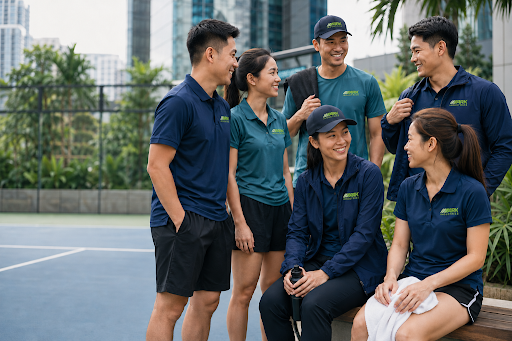
Corporate Sports Apparel Now Has a Longer Working Life
Corporate teamwear has traditionally been commissioned around a specific occasion. A company signs up for a tournament, produces a shirt with the event name and distributes it shortly before the competition.
This approach serves the immediate requirement, but it can limit the usefulness of the garment. Once the event date has passed, an oversized tournament graphic may make the apparel feel outdated. Employees may be less likely to wear it during training, at future events or in more professional settings.
An embroidery-led approach can extend the relevance of the apparel by separating the organisation’s permanent identity from temporary event information.
A company logo, team crest or department mark can be embroidered onto the garment, while event-specific details are handled through a removable badge, secondary print or separate accessory. The core apparel can then be reused for future tournaments, internal training sessions, volunteer activities and company wellness programmes.
This creates a more practical system: the organisation invests in a recognisable team identity once, rather than redesigning the entire garment for every event.
Embroidery Gives the Team a More Established Identity
There is a visual difference between a shirt created for participation and apparel designed to represent an established team.
A carefully embroidered crest or company mark gives the garment structure and permanence. Because the design is stitched directly into the fabric, it can resemble the visual language used by sports clubs, associations and professional teams. This makes embroidery particularly effective when a company wants its team to feel like an ongoing internal community rather than a temporary group assembled for one event.
This distinction matters for employee participation. A corporate team develops greater internal recognition when its identity remains consistent across seasons, activities and new team members.
The same embroidered mark might appear on:
- performance polo shirts worn during less intensive events;
- warm-up jackets used before and after matches;
- caps or visors for outdoor activities;
- quarter-zip tops for training;
- team bags used across multiple competitions; and
- presentation apparel worn during prize-giving or company photography.
Used consistently, these pieces create a recognisable corporate sports identity without requiring every garment to carry a large logo.
It Strengthens the Corporate Brand Without Overpowering the Sportswear
Corporate sports apparel must balance two identities. It needs to feel energetic and appropriate for sport, but it must also represent the organisation behind the team.
Placing an oversized corporate logo across every garment can make the apparel resemble promotional merchandise rather than considered sportswear. A smaller embroidered mark offers a more restrained alternative.
Common placements include the left chest, upper sleeve, collar, side panel or front of a cap. These positions keep the company visible while allowing the garment’s cut, team colours and performance details to remain central to the design.
This approach is particularly relevant when employees will be photographed, compete alongside other organisations or attend an event where clients and business partners are present. The apparel should look unified at a distance and remain polished when viewed more closely.
Embroidery can also support a structured brand hierarchy. The company logo may occupy the primary chest position, while a team name, player initials or activity-specific emblem appears elsewhere. This allows the apparel to communicate both corporate ownership and team identity without overcrowding the garment.
Custom Embroidery Can Support Personalisation Without Losing Consistency
Corporate teams often include employees from different departments, locations and levels of seniority. Personalisation can help individual members feel that the apparel belongs to them, but too many variations can weaken the overall team identity.
Embroidery provides a controlled way to introduce individual details.
Names, initials, team roles or small squad identifiers can be added while the main logo, colour palette and placement remain consistent. This creates personal recognition without turning each garment into a separate design.
A clear embroidery system may specify:
- one approved version of the corporate logo;
- a fixed logo size and placement;
- an approved thread colour palette;
- a standard typeface for names or initials;
- a maximum character count; and
- separate placement rules for different garment types.
Establishing these details before production makes future reorders easier. When new employees join the team, additional pieces can be produced according to the same standard rather than redesigned from the beginning.
The Method Is Well Suited to Reusable Off-Court Apparel
Embroidery is sometimes discussed as though it is suitable for every type of sports garment. It is not.
Dense embroidery adds thread and weight to the area where it is applied. On very lightweight, highly elastic or close-fitting performance jerseys, a large embroidered design may affect drape, flexibility or comfort. In these cases, sublimation, heat transfer or another lightweight branding method may be more appropriate.
The strongest corporate sports apparel systems therefore do not force one decoration method onto every item. They use embroidery where it performs best.
Embroidery is generally well suited to:
- structured performance polo shirts;
- warm-up and presentation jackets;
- caps and visors;
- quarter-zips and sweatshirts;
- team bags;
- towels; and
- selected midweight training tops.
Lightweight printing or sublimation can then be used for match jerseys that require maximum breathability and unrestricted movement.
This hybrid approach gives the company the permanence and finish of embroidery on reusable items while preserving the performance qualities required during more intensive activity.
Singapore’s Climate Makes Garment Selection Especially Important
Corporate sports apparel in Singapore must perform in a consistently warm and humid environment. The Meteorological Service Singapore identifies high humidity, relatively uniform temperatures and abundant rainfall as defining features of the country’s climate.
These conditions make the base garment just as important as the embroidered design. An attractive logo cannot compensate for a shirt that retains too much heat, dries slowly or becomes uncomfortable during movement.
For outdoor and active use, businesses should consider garments with:
- breathable or moisture-managing fabric;
- sufficient structure to support the embroidery;
- ventilation in high-heat areas;
- an appropriate fit for the intended activity;
- colourfast fabric suitable for repeated washing; and
- seams and trims that will not cause discomfort during movement.
The embroidery itself should also be adjusted to suit the garment. A design prepared for a heavyweight cotton polo should not automatically be applied to a lighter performance fabric using the same stitch density and backing.
Testing the complete combination of logo, fabric and placement is essential before bulk production.
Proper Digitisation Determines the Quality of the Result
A digital logo file cannot simply be sent to an embroidery machine and stitched correctly without preparation.
The artwork must first be digitised. This is the process of converting the design into embroidery instructions that control stitch direction, stitch type, density, sequence and underlay. Good digitisation accounts for how thread interacts with the specific fabric, rather than treating embroidery as a printed image.
This is especially important for corporate logos containing:
- small lettering;
- narrow lines;
- multiple colours;
- enclosed spaces;
- gradients or fine detail; and
- registered symbols or taglines.
Some elements that work clearly on a screen may not remain legible when reduced to a small chest or cap application. Increasing stitch density is not always the answer, as excessive stitching can stiffen the garment, distort the fabric or close the spaces within small lettering.
A capable embroidery partner should advise whether the logo needs to be simplified, resized or adapted into a dedicated small-format version. This protects the integrity of the brand while ensuring the final mark can be reproduced cleanly.
A Pre-Production Sample Reduces Avoidable Errors
Colour references and digital mock-ups are useful, but neither can fully demonstrate how embroidery will behave on the selected garment.
Thread reflects light differently from printed ink, and the same colour can appear different depending on the surrounding fabric. Logo placement can also shift visually when a garment is worn rather than laid flat.
Before approving a full order, businesses should assess an actual pre-production sample for:
- logo dimensions;
- placement on the worn garment;
- thread colour;
- legibility of small text;
- fabric puckering or distortion;
- backing comfort against the skin;
- overall stitch coverage; and
- consistency with the organisation’s brand guidelines.
The approved sample should then be photographed and documented. This provides a reliable reference for production, internal approval and future reorders.
For organisations operating several teams or offices, maintaining this approved specification is particularly valuable. It reduces the risk of different departments ordering inconsistent versions of the same corporate teamwear.
Better Apparel Can Encourage Continued Use Beyond the Event
The value of corporate sports apparel should not be measured only by how it appears on competition day. It should also be assessed by whether employees choose to wear it again.
A garment that is comfortable, well fitted and appropriately branded may continue to be used for training, informal company activities, travel, volunteering or future sporting events. This extends the practical lifespan of the order and keeps the organisation’s identity visible without requiring additional promotional merchandise.
Continued use cannot be achieved through embroidery alone. Fabric, fit, sizing, colour and garment type all influence whether employees will wear the apparel voluntarily.
However, restrained embroidered branding can make the garment easier to reuse because it is less tied to a single date or campaign. It allows the apparel to feel like part of a team wardrobe rather than a souvenir from one event.
Planning Custom Embroidered Sports Apparel for a Corporate Team
A successful order begins with a clear understanding of how the apparel will be used.
Before selecting a garment or decoration method, organisations should confirm:
- The activity
Apparel for a running event will have different requirements from clothing used for golf, bowling, football or pickleball. - The level of physical intensity
High-intensity matchwear may require a lighter branding method, while embroidery may work well on presentation or warm-up pieces. - The intended lifespan
If the apparel will be reused across several events, permanent corporate branding should be separated from event-specific information. - The wearer profile
Size range, fit preferences, modest-wear requirements and garment cuts should be considered before quantities are confirmed. - The logo format
Detailed logos may need a simplified embroidery version to remain legible at a smaller size. - The ordering schedule
Time should be allocated for artwork preparation, digitisation, sampling, approval, production and any necessary amendments. - Future reorders
Approved artwork, thread colours, garment codes and placement measurements should be recorded so additional pieces can be produced consistently.
These decisions help the business avoid treating apparel as a last-minute event purchase. Instead, the order becomes a repeatable system that can support the team over a longer period.
From One-Day Uniform to Long-Term Team Asset
Team bonding may be the reason a corporate sports programme begins, but it is not the only value the programme can create.
A visible and consistent team identity can support participation, strengthen internal recognition and give employees something tangible that connects them to the organisation outside their usual working environment. When the apparel is sufficiently well designed to be used again, it also delivers more value than a garment created for a single date.
Custom embroidery has an important role within this system, particularly for reusable polos, jackets, caps and off-court apparel. Its effectiveness, however, depends on appropriate garment selection, careful digitisation and a clear understanding of where embroidery is preferable to lighter decoration methods.
Ark Industries works with Singapore businesses to develop custom embroidered sports apparel that balances corporate identity, wearer comfort and the practical demands of each activity. Our process covers garment selection, logo digitisation, placement planning and pre-production sampling, helping organisations establish teamwear that can be reproduced consistently across events and seasons.
Businesses planning apparel for an upcoming tournament, corporate wellness programme or inter-company league can contact Ark Industries to discuss a suitable teamwear system or explore our embroidery services in Singapore to learn more about creating a durable and consistent embroidered identity.